Brace Use in Scoliosis
- Brace Use in Scoliosis
- Definition of Scoliosis
- General Approach to the Treatment of Scoliosis
- Purpose of Brace Use in Scoliosis
- Indications for Brace Treatment
- Types of Scoliosis Braces
- Duration of Brace Use and Compliance
- Relationship Between Bracing and Exercise
- Conclusion and Clinical Evaluation
Definition of Scoliosis
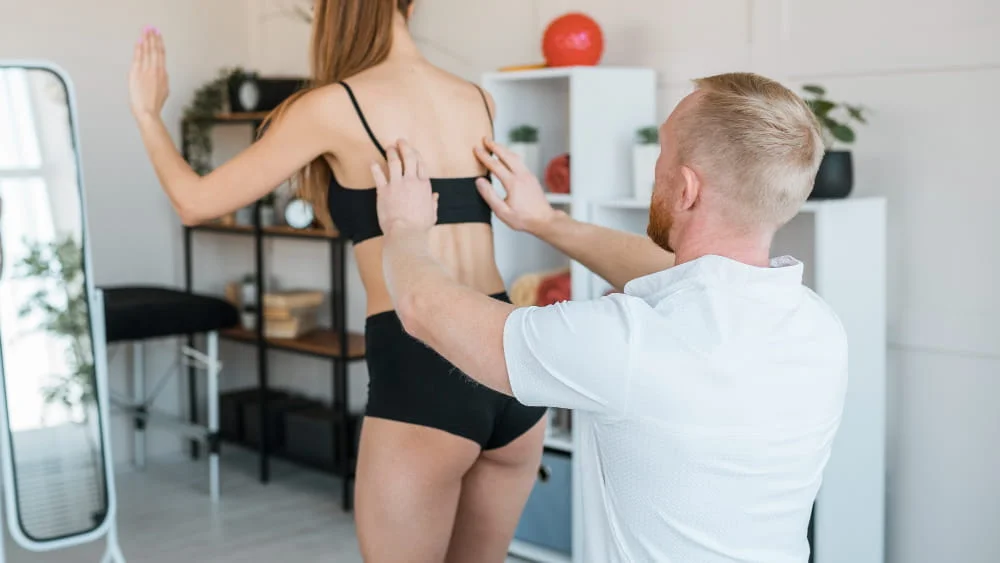
Scoliosis is a three-dimensional spinal deformity characterized by a lateral curvature of more than 10 degrees in the frontal plane, most often accompanied by rotational deformity. It is not limited to lateral bending alone; it includes complex biomechanical changes such as rotation of the vertebrae around their own axis and disruption of thoracic and pelvic balance. Therefore, scoliosis should be considered not merely a postural disorder, but a progressive musculoskeletal condition that requires close monitoring during the growth period.
Scoliosis is most commonly seen in the form of adolescent idiopathic scoliosis. In addition, congenital, neuromuscular, syndromic, and degenerative types of scoliosis are also encountered in clinical practice. Particularly in individuals with remaining growth potential, the risk of curve progression is the main factor guiding treatment decisions.
General Approach to the Treatment of Scoliosis
Scoliosis treatment is planned by taking into account:
- The degree of curvature (Cobb angle).
- The patient’s age and skeletal maturity,
- The localization and pattern of the curve,
- The risk of progression.
Treatment options are generally considered under three main categories:
- Observation (follow-up)
- Conservative treatment (exercise and bracing)
- Surgical treatment
Brace treatment, which is the focus of this text, is one of the most important conservative treatment methods, especially in scoliosis cases that do not require surgery but carry a risk of progression.
Purpose of Brace Use in Scoliosis
The primary aim of brace treatment is not to completely correct the existing curvature, but to stop or slow the progression of the curve during the growth period. At this point, an important emphasis should be made: a brace does not “cure” scoliosis, but helps to control it.
The goals of brace use are as follows:
- To prevent progression of the curvature
- To reduce or delay the need for surgery
- To maintain spinal balance
- To limit trunk asymmetry
In order to achieve these goals, brace treatment must be applied with appropriate patient selection, the correct type of brace, and high patient compliance.
Indications for Brace Treatment
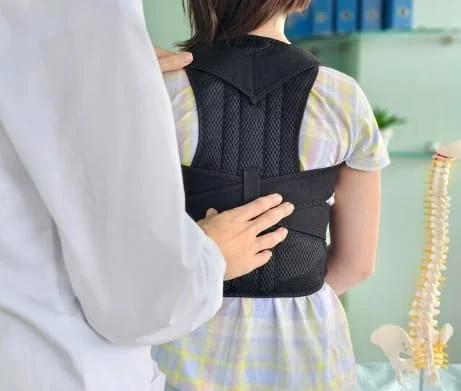
Brace use is generally recommended for patients who meet the following criteria:
- A Cobb angle between 20–40 degrees
- Incomplete skeletal maturation (Risser 0–2)
- Ongoing growth potential
- Presence of curve progression or risk of progression
In severe curvatures (>45–50 degrees) or after completion of growth, the effectiveness of brace treatment is limited. Therefore, timing is extremely critical in brace therapy.
Types of Scoliosis Braces
Braces used in clinical practice vary according to the patient’s curve characteristics and the purpose of use. The most commonly used types of braces are:
- Boston Brace: The most widely used thoracolumbosacral orthosis. It has a structure that encircles the trunk and can be worn under clothing.
- Milwaukee Brace: An older model that includes a neck ring, preferred especially for upper thoracic curves.
- Chêneau and its derivatives: Modern, custom-made braces based on the principle of three-dimensional correction.
- Night-time braces (Charleston, Providence): Designed for night use only and preferred in selected patient groups.
Brace selection should always be made through the collaboration of a Physical Medicine and Rehabilitation specialist, an orthopedist, and an experienced orthotist-prosthetist.
Duration of Brace Use and Compliance
One of the most important factors determining the success of brace treatment is the duration of use. In most cases, wearing the brace for 18–23 hours per day is recommended. Studies have shown that as brace wear time increases, the rate of preventing progression rises significantly.
However, especially during adolescence, compliance with brace use may be challenging due to:
- Aesthetic concerns
- Social pressure
- Physical discomfort
For this reason, thorough education of the patient and family, provision of psychosocial support, and regular follow-up are of great importance.
Relationship Between Bracing and Exercise
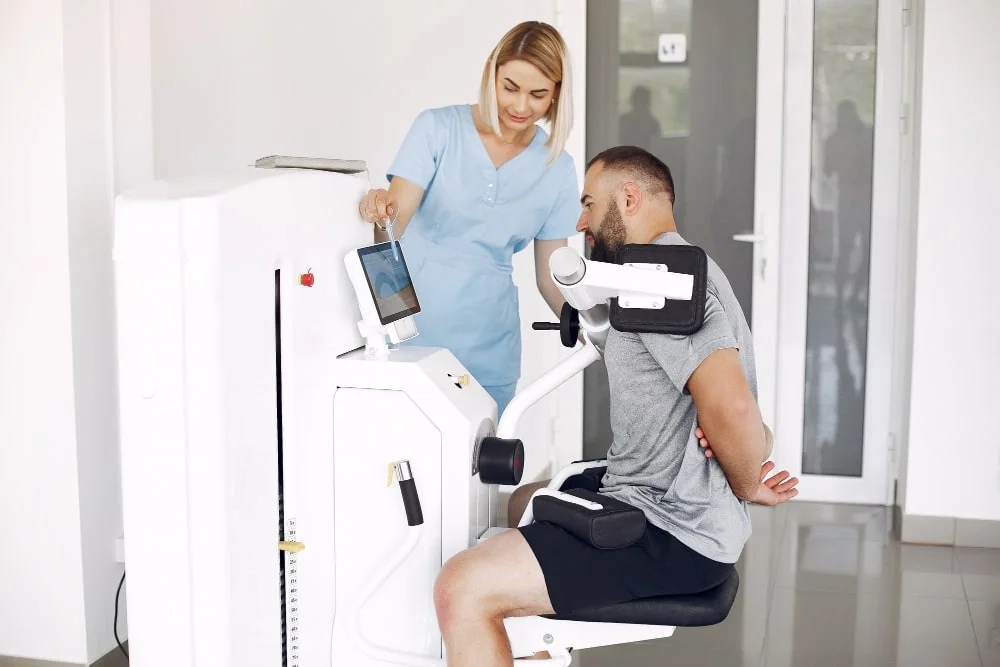
Brace treatment should be applied together with scoliosis-specific exercise programs. Brace use alone may be insufficient to correct muscle imbalances. Exercises performed under the supervision of physical therapy:
- Improve postural control
- Support respiratory capacity
- Prevent muscle weakness associated with brace use
Therefore, in modern approaches, bracing and exercise therapy are considered complementary methods.
Conclusion and Clinical Evaluation
Brace use in scoliosis is an effective, evidence-based conservative treatment method that reduces progression to surgery when applied with appropriate indications. However, it is not suitable for every scoliosis patient and requires an individualized treatment plan.
As Physical Medicine and Rehabilitation specialists, our primary goal is to evaluate the patient not only radiologically, but also in terms of functional, psychological, and social dimensions, and to protect long-term spinal health. Brace treatment is an important component of this holistic approach; however, its success is possible only with patient–physician cooperation and regular follow-up.

Dr. Elif Berber
Assistant Professor
Physical Medicine and Rehabilitation Specialist