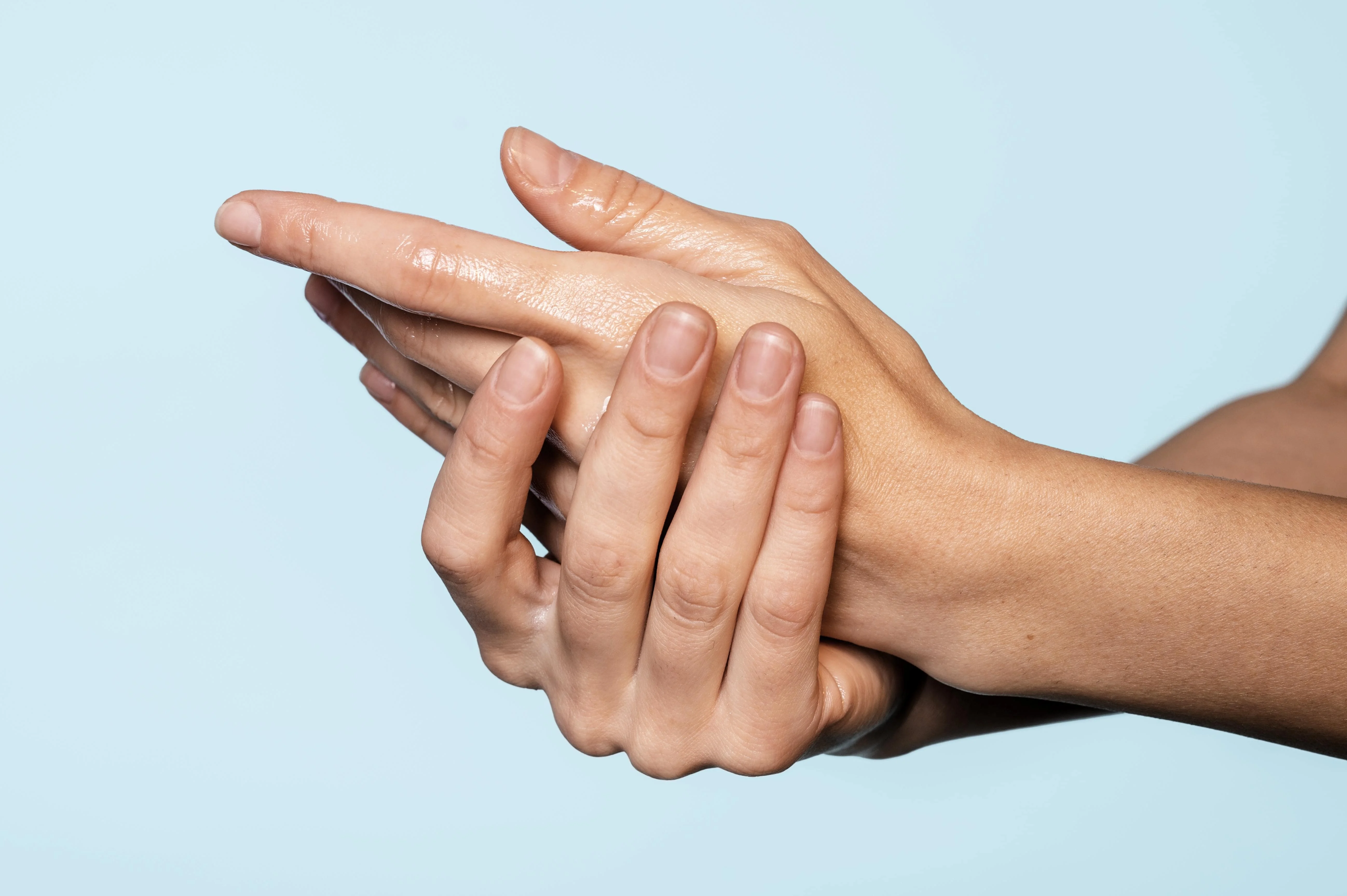
Dupuytren’s Contracture and the Role of Physical Therapy
- Dupuytren’s Contracture and the Role of Physical Therapy
- To Understand the Condition More Easily
- The Role of Physical Therapy in the Early Stage
- Physical Therapy After Contracture (Finger Bending) Develops
- Postoperative Physical Therapy (The Most Important Stage of Treatment)
- Our Main Postoperative Goals:
- Conclusion
Dupuytren’s contracture is a progressive hand condition in which the thick connective tissue in the palm gradually hardens and pulls the fingers inward, causing them to bend. The ring and little fingers are most commonly affected. This condition can make daily activities difficult. As Physical Medicine and Rehabilitation specialists, we emphasize that physical therapy plays an important role at every stage of this disease.
To Understand the Condition More Easily
In Dupuytren’s contracture, the problem stems from the palmar fascia (the connective tissue covering the palm), which becomes thickened and hardened. Small firm nodules appear first. Over time, these nodules turn into cord-like bands that make it difficult to fully straighten the fingers. This process does not progress at the same rate in everyone.
While it remains stable for years in some individuals, it may progress more rapidly in others.
The Role of Physical Therapy in the Early Stage
In the early stage of the disease, when the fingers have not yet begun to bend, the goals of physical therapy are:
• Reducing tension in the palm
• Relieving pain or sensitivity if present
• Delaying weakness and loss of function in the fingers
• Making daily hand use more comfortable
The methods we use in this phase can be summarized for the general public as follows:
- Manual Therapy (Hands-on relaxation techniques)
• Soft-tissue massage applied to the palm and fingers
• Fascia-release techniques (methods to soften the tight tissue)
These techniques help reduce tension and improve mobility. - Stretching Exercises
Regular stretching may slow the progression.
For example:
• Gently opening the fingers
• Expanding the palm
• Moving each finger joint individually - Splint / Orthosis (Night-time support device)
Night extension splints can slow finger bending.
They are not a treatment on their own; they are effective when combined with exercises. - Training on Daily Hand Use
To prevent the disease from disrupting hand function, we teach proper hand use during daily activities.

Physical Therapy After Contracture (Finger Bending) Develops
When noticeable finger bending begins, the treatment goals change:
• Preserving existing movement
• Reducing stiffness and pain
• Adjusting hand functions to daily-life needs
• Preparing the patient for surgery if necessary
The methods we use at this stage include:
- Joint Mobilization (Techniques to loosen and open the joints)
These are special manipulations performed to allow easier finger movement. They are performed gently and in a controlled manner. - Heat and Electrotherapy
• Heat applications
• Ultrasound (a device that provides deep-tissue warming)
• TENS (a mild electrical current that reduces pain)
These applications increase tissue flexibility and make exercises easier. - Strengthening Exercises
Since finger and hand weakness can develop:
• Grip-strength exercises
• Opening-and-closing movements
• Fine-motor skill exercises
are performed. - Functional Rehabilitation
Our goal is to help the patient use the hand more easily in daily activities.
Writing, holding objects, opening jars, and carrying items are specifically practiced.
Postoperative Physical Therapy (The Most Important Stage of Treatment)
Dupuytren’s contracture sometimes requires surgery. However, surgery alone is not sufficient. Without postoperative physical therapy, the following issues are more likely to occur:
• Stiffness
• Re-contracture
• Loss of movement
• Excessively hardened scar tissue
Therefore, postoperative rehabilitation is extremely important.
Our Main Postoperative Goals:
- Wound Care and Swelling Control
• Reducing hand swelling
• Ensuring proper healing of the incision
• Scar massage when needed - Early Movement
We begin controlled finger-opening and finger-closing exercises as early as the surgeon allows. - Splint (Orthosis) Use
A night splint is essential after surgery to reduce the risk of recurrence.
If necessary, custom-made dynamic (movable) splints may also be used. - Muscle Strengthening and Functional Training
We help the hand gradually regain its former strength and functional abilities.
Conclusion
Dupuytren’s contracture is a hand condition that can progress over time. However, with properly applied physical therapy:
• The progression of the disease can be slowed
• Movement in the hand can be preserved
• Daily life can become more comfortable
• Surgical outcomes become significantly more successful if surgery is needed
As Physical Medicine and Rehabilitation specialists, we evaluate each patient individually and create a personalized treatment plan based on the stage of the disease, the degree of finger involvement, and the patient’s daily-life needs.
Physical therapy is not merely supportive in Dupuytren’s contracture; it is a core component of treatment.
Dr. Elif Berber, PhD
Specialist in Physical Medicine and Rehabilitation